The Search Four: How to Win the Lead-to-Sale Journey in the Age of AI
Google's Search Four framework, broken down: data strength, bidding goals, AI targeting and demand-led budgets. Plus a 30-day rollout order.
By Prince PandeyPublished 7 min read
In this article
Most lead gen accounts are not underperforming because of bad keywords or weak creative. They are underperforming because Google's AI is being taught the wrong lesson.
Every form fill you count as a conversion is a vote. If you count all leads equally, you are telling the algorithm that a tyre-kicker and a sales-qualified buyer are worth the same thing. It listens, and it goes out and finds you more of whatever is cheapest to get.
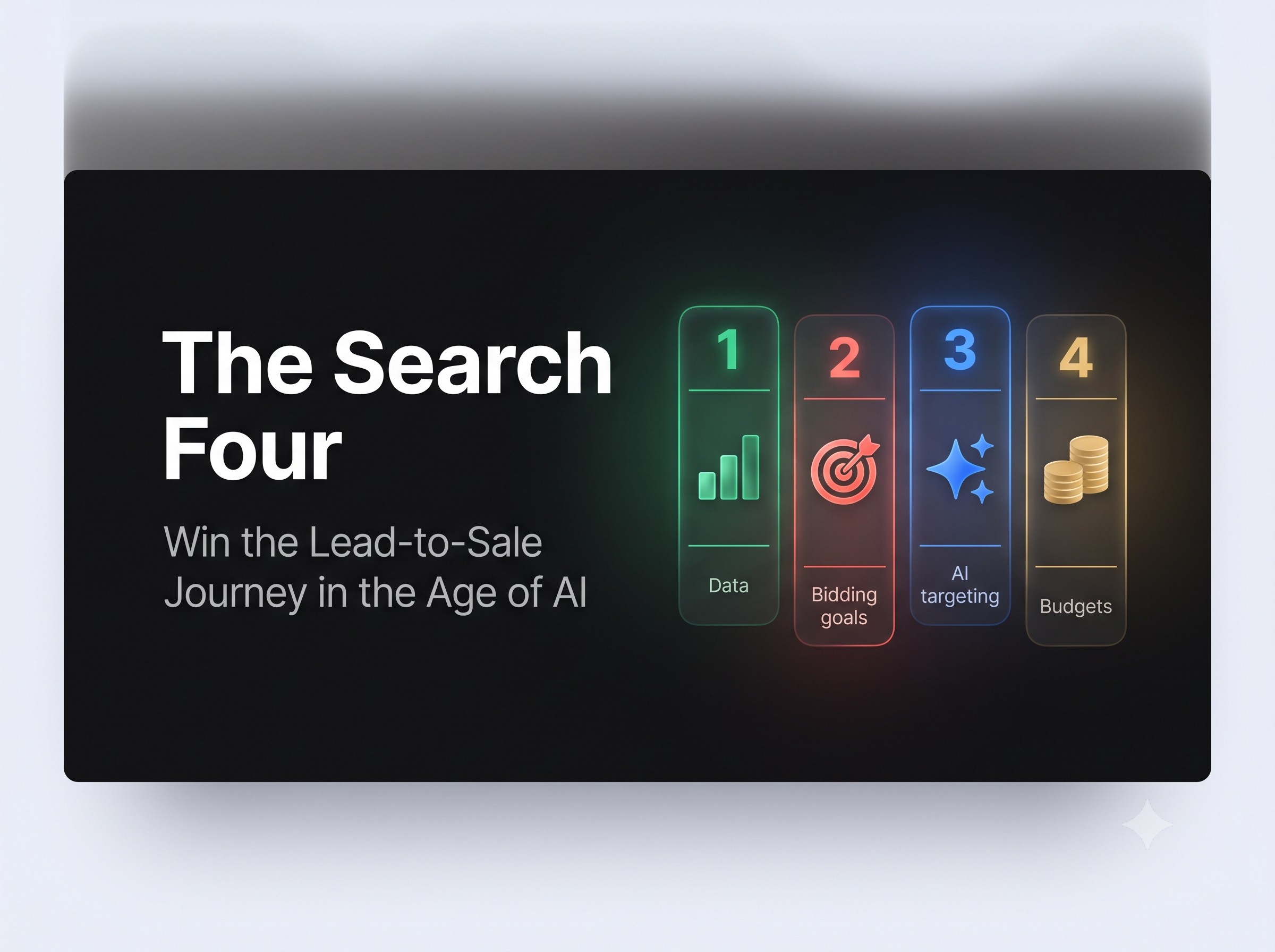
Google's answer to this is a four-part framework called the Search Four. Having run Google Ads across 40+ accounts in Australia, the UK, the US and India, I can say the sequence matters as much as the tactics. Get pillar one wrong and the other three amplify the mistake.
Here is what each pillar actually means, and how to implement it.
Pillar 1: Data strength
Goal: teach Google AI what a good customer looks like.
This is the foundation. Smart Bidding can only optimise toward the signals you feed it, so weak conversion data caps your ceiling no matter how much budget you add.
Three actions:
Complete your lead journey mapping. Write out every stage from click to closed revenue: form fill, contacted, qualified, opportunity, sale. Decide which stages are worth bidding toward. For most B2B and high-ticket accounts, the answer is qualified lead or better, not raw form fills.
Maximise post-lead offline conversion signals. Push CRM outcomes back into Google Ads Data Manager as offline conversions, with distinct actions for "qualified lead" and "converted lead". This is the single highest-leverage change available to most lead gen accounts, and it is the one most teams skip because it needs sales buy-in.
Upgrade to Google tag gateway. First-party tagging captures form submissions more reliably as browser restrictions tighten. Measurement loss is not a tracking inconvenience, it is a bidding problem.
Practitioner note: assign values, not just labels. A qualified lead at 1, an opportunity at 5, a closed deal at 25. Value-based signals give tROAS something real to chase.
Pillar 2: Bidding goals
Goal: align Smart Bidding with the KPI your business is actually judged on.
Once quality signals are flowing, move the bid strategy onto them.
Optimise toward the down-funnel action, not the top-funnel one. Target CPA on "qualified lead" behaves very differently from target CPA on "form submitted".
If revenue data is available, switch to target ROAS with value-based conversions.
Expect CPA to rise and lead volume to fall when you make this change. That is the point. You are trading cheap leads for leads the sales team can close.
Give the strategy a full conversion cycle before judging it. Changing targets weekly is the fastest way to destroy learning.
A common failure I see in audits: the account is technically well-built, but bidding is optimised to the easiest conversion action in the account. The algorithm is performing perfectly against the wrong instruction.
Pillar 3: AI targeting and creatives
Goal: let AI find demand you would never have keyworded, inside guardrails you control.
AI Max for Search campaigns extend reach beyond your exact keyword set using search intent matching. Use brand exclusions, locked assets and negative keyword lists so expansion stays on-brand. Treat it as an addition to a solid Search structure, not a replacement.
Performance Max covers the rest of Google's inventory. Feed it strong first-party audience signals, and use brand guidelines and URL exclusions to keep output aligned.
Native lead formats scale qualified volume where the form is the friction point: Lead Form Ads for fast capture, Call Ads for high-intent service categories, Message Ads for mobile-first markets.
Keep asset variety high. Weak creative is the most common bottleneck in AI-driven campaigns, because the system has nothing good to test.
Controls are not the enemy of automation. They are what make automation safe to scale.
Pillar 4: Demand-led budgets
Goal: stop capping campaigns that are already profitable.
Check your lost impression share due to budget. If profitable campaigns are limited, you are choosing to leave revenue on the table.
Use flighted budgets around genuine demand peaks: Q4, product launches, seasonality, event windows.
Budget by outcome, not by habit. Fund what returns, starve what does not.
Review pacing weekly during peak periods, not monthly.
A 30-day rollout order
Week 1: Map the lead journey with sales. Agree on what "qualified" means in writing.
Week 2: Implement Google tag gateway. Set up offline conversion import into Data Manager.
Week 3: Validate the data flow, then switch bid strategies to the down-funnel action.
Week 4: Layer in AI Max or Performance Max with controls, add native lead formats, lift budget caps on winners.
Do not start at week three. Bidding on signals you have not yet built is how accounts stall.
Mistakes to avoid
Counting every form fill as a conversion.
Running AI campaigns with no brand controls or exclusions.
Judging a new bid strategy inside the learning period.
Treating measurement as an analytics job rather than a media job.
Adding budget before fixing signal quality.
FAQ
What is the Google Search Four?
A four-pillar framework for AI-driven lead generation: data strength, bidding goals, AI targeting and creatives, and demand-led budgets.
Why should I optimise for qualified leads instead of leads?
Because Smart Bidding finds more of whatever you reward. Reward raw volume and you get volume. Reward qualified leads and you get pipeline.
What is AI Max for Search?
A set of AI-powered targeting and creative features that extend Search campaigns beyond your keyword list using intent matching, with brand and asset controls you configure.
Do I need a CRM to do this properly?
You need some way to send outcome data back to Google Ads. A CRM makes it easier, but a spreadsheet upload beats no signal at all.
How long before results show?
Expect two to four weeks of noisier data after a bidding change, then a clearer read on lead quality by week six.
About the author
Prince Pandey is a performance marketer with 3.5 years of agency-side PPC experience, currently a Key Account Manager at WTechy, where he manages 40+ accounts across Google, Meta, LinkedIn and TikTok for clients in Australia, the UK, the US and India. He works with brands on lead quality, conversion signal architecture and AI-led campaign structures under The Marketing Freak. More at marketingbyprince.com and LinkedIn.
About the author

Performance Marketer
Performance Marketer | SEO & PPC Specialist | Expert in Meta Ads, Amazon Ads, and WA Marketing | Helping Businesses Maximizing Online Visibility
Related case studies
- Google Ads302Tracked Conversions
Scaling IPTV Player – Live Xstream Through Data-Driven Google Ads
A Google Ads App Campaign strategy that moved IPTV Player – Live Xstream from install-volume acquisition to higher-intent, login-optimized user growth.
$0.74 cost / conversion
Read case study - Google Ads4.76xFinal ROAS
How Cutting Wasted Search Spend Turned a 1.29 ROAS Account Into a 4.76 ROAS Growth Engine
How cutting wasted Search spend turned a 1.29 ROAS Google Ads account into a 4.76 ROAS growth engine for an Australian refurbished-tech retailer.
-79% cost/conversion
Read case study